
The Fourth Dimension
In 1751 the Swedish botanist Carl Linnaeus proposed in his book Philosophia Botanica a very uncommon way of measuring time – with a flower garden. Given plants open and close their flowers at precisely set times, according to which he composed a clock with twelve floral sections. He described three groups of flowers: a) meteoric flowers, those that change their time of opening and closing depending on weather conditions; b) tropical flower...read more
The Fourth Dimension
In 1751 the Swedish botanist Carl Linnaeus proposed in his book Philosophia Botanica a very uncommon way of measuring time – with a flower garden. Given plants open and close their flowers at precisely set times, according to which he composed a clock with twelve floral sections. He described three groups of flowers: a) meteoric flowers, those that change their time of opening and closing depending on weather conditions; b) tropical flowers, flowers that change their time of opening and closing depending on the length of day; c) equinoctial flowers, which have a fixed time to open and close their petals. Only the last are suitable for a floral clock. For example, the dandelion (Taraxacum officinale) opens at 5, the Savoy hawkweed (Hieracium sabaudum) opens at 7 and closes between 13 and 14 hours; the pot marigold (Calendula officinalis) closes at 15 hours. Although it is dubious just how accurate this kind of clock would be because of the different factors that affect the opening of the flowers, like height above sea level, climate and so on, Linnaeus’ horologium florae is aesthetically a luxuriant and romantic idea for the measurement of time. His clock that grows out of the ground, or garden, is not exactly practical to carry about with you, but if we are at home, we can certainly enjoy the flowers while, if we know their rhythm, having an idea of what time it is.
In contrast to this biological, living plant clock, the most accurate in the world is the atomic clock NIST F1 which is connected with the frequency of resonance of the atom. According to it, a second is defined as 9 192 531 770 oscillations of an atom of caesium. A North American kind of cicada, the Magicicada septemdecim, stays underground for 17 years, then emerges, mates, after which it soon dies. And this too is a way of recording the time, if we are not too much concerned with trivial units of measurement like months, weeks, days, hours, minutes, not to mention other measurements like the Planck time unit (10 -44 of a second), which is a measurement for the speed of light – the shortest time that can ever be measured or the attosecond (10-18 of a second) the shortest time that has been able to be measured so far. And the cicadas, like us, will never experience a yottasecond (which measures 31.7 quadrillion years) or the cosmological decade (which is ten times longer than the previous cosmological decade, measured from 10 seconds after the Big Bang). Such units of measurement for time can be conceptualised by such scientists as astrophysicists. They, for example, refer to the only time during which life on earth was possible as a “lucky moment.” This moment, of some four and a half billion years, is the happy circumstance that permitted the existence of both us and our sun.
Among the opening of flowers, the oscillations of atoms and cicadas there are many other signs for the measurement of time, like the sun, moon, stars, other animals, our hearts, mechanical and digital clocks and watches. But all clocks and calendars are actually ways of measuring time, or more precisely, the measurement of temporal intervals, because we cannot measure pure time. Calendars, clocks, timelines and other ways of measuring time relate to time as the arrow of time – a one-way experience of time in which an event is irreversible. Theoretical physics claims that parallel worlds are possible and that “our universe may be one of many and the three dimensional world merely a mirage,” as documentary film The illusion of time, claims. For it is possible that there is no difference between past, present and futures in the cosmological tissue. Einstein discovered that the perception of time slows down on motion through space, and also that gravitation affects the perception of time. In our earthly framework it is hard to feel it, but theoretical physics claims that if a man were to approach a black hole, and if he spent about two hours close to it, on Earth a time of 50 years would have passed. This discovery opened a Pandora's Box of thoughts about time as concept that exists in a linear sense only in certain circumstances, for in that moment when the physical conditions change, parallel worlds, time travel and similar intriguing ideas that we experience primarily as part of SF literature or the imaginary of Hollywood might well occur.
If the Big Bang is taken as the moment of the least entropy, or the most orderly state of the Universe, which is tending towards ever greater disorder, i.e. greater entropy, which according to the most up to date physics research is accelerating and not slowing down, then the end of time is waiting for us. The accelerated increase of entropy will end with the loss of connection with the past. Time will lose its meaning, for in the Universe there will be no change, and if there is no change, there is no time either.
What is it, then, that we cannot measure in itself, only parts of it? What is time? Is time dependent or independent of us? Is it a matter of convention or a fact? Is it the measure of change? Do passage and duration exist? Do present, past and future change according to our relation in space and time? Do the present, the past and the future really exist? Since Aristotle, Augustine, Kant, Heidegger, Newton, Einstein and many other philosophers and scientists, time has been one of the most intriguing of concepts. Biological time, linear and cyclical time, quantum time, astronomical time, the space-time continuum, the time arrow, geological time, synchronicity, eternity, wormholes (short cuts through the space-time continuum), and the perception of time are just some of the sub-topics that indicate the scope of temporal multifariousness.
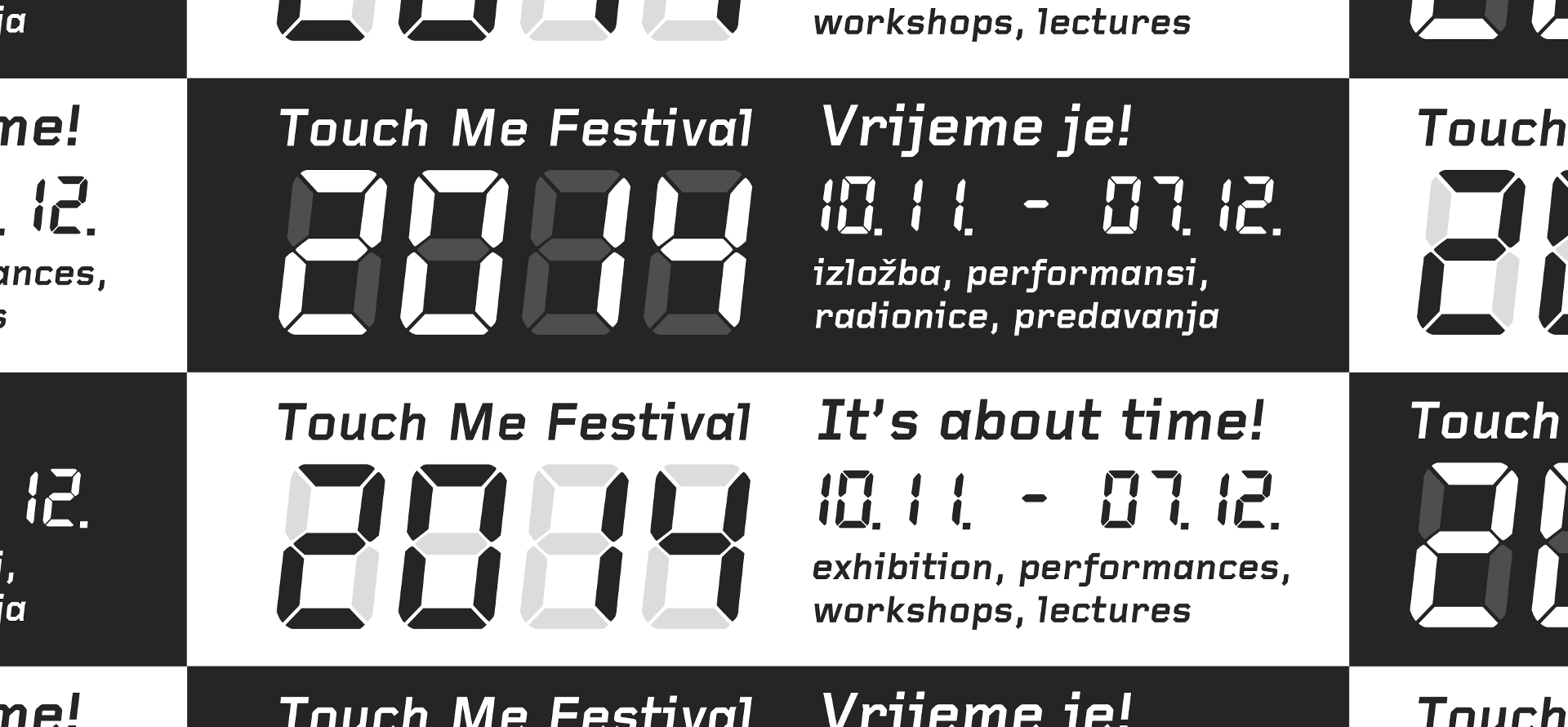
The Touch Me Festival is an international triennial transdisciplinary project dedicated to the progressive integration of art, science and technology, and has existed since 2003. In 2014, in its fourth edition, Touch Me Festival: It's about time! deals with the theme of time through innovative concepts of contemporary scientific and artistic research. Fascination with time is common to the artistic and to the science-and-technology community and is one of the places of their most thorough permeation, while the dynamics of scientific advances combined with the power of the artistic vision deconstructs social and cultural paradigms and generates new, unconventional, hybrid perspectives that look at time critically, innovatively and provocatively.
Olga Majcen Linn & Sunčica Ostoić | Kontejner
* LECTURES
All lectures will be held in English.
** KLOVIĆEVI DVORI GALLERY OPENING TIMES
Tuesday – Sunday 11:00 – 19:00 h, closed on Mondays and holidays.
ADMISSION FOR THE EXHIBITION
Lectures, performances and workshops: entrance free.
Exhibition tickets are available at Klovićevi dvori Gallery box-office.
Single visit
15,00 kuna – regular single ticket
10,00 kuna – schoolchi...read more
* LECTURES
All lectures will be held in English.
** KLOVIĆEVI DVORI GALLERY OPENING TIMES
Tuesday – Sunday 11:00 – 19:00 h, closed on Mondays and holidays.
ADMISSION FOR THE EXHIBITION
Lectures, performances and workshops: entrance free.
Exhibition tickets are available at Klovićevi dvori Gallery box-office.
Single visit
15,00 kuna – regular single ticket
10,00 kuna – schoolchildren / students / retired persons and persons older than 65
5,00 kuna – visitors of the Museum of Broken Relationship with a valid ticket
Free entrance for preschool children.
Group visits
5,00 kuna – single ticket for all group visits
EXHIBITION GUIDED TOURS
Free guided tours for general public:
Tuesday and Thursday at 18:00 h
Wednesday, Friday and Sunday at 12:00 h
Saturday at 12:00 h and 18:00 h
Group guided tours in Croatian and a foreign language on prior notice at tel. no. 095/8261 492.
Guided tours are available for elementary and secondary schools, universities, disable persons and others.
For further information call 095/8261 492. Guided tours coordinator: Patricia Počanić.
***WORKSHOPS
Applications for workshops send to email jelena@kontejner.org or call 091/7203 963. We can receive applications up to November 28.
For all other information contact:
KONTEJNER | bureau of contemporary art praxis
Kvaternikov trg 2, Zagreb
e-mail: kontejner@kontejner.org
www: kontejner.org
tel.: 01/7788 204
public relations: Jelena Matičić, jelena@kontejner.org, 091/7203 963
Klovićevi dvori Gallery
Jesuit Square 4
e-mail: info@galerijaklovic.hr
www: galerijaklovic.hr
tel: 01/4851 926
public relations: Gordana Bralić, goga.bralic@galerijaklovic.hr, 091/2525 898
Touch Me Festival 2014: It's about time!
November 10th – December 7th 2014
Klovićevi dvori Gallery, Jezuitski trg 4
Institute of Physics, Bijenička 46
Ruđer Bošković Institute, Bijenička 54
Faculty of Electrical Engineering and Computing, KSET, Unska 3
Academy of Fine Arts, Ilica 85
project concept: KONTEJNER | bureau of contemporary art praxis, Zagreb
curatorial team: Olga Majcen Linn, Sunčica Ostoić | KONTEJNER, Marta ...read more
Touch Me Festival 2014: It's about time!
November 10th – December 7th 2014
Klovićevi dvori Gallery, Jezuitski trg 4
Institute of Physics, Bijenička 46
Ruđer Bošković Institute, Bijenička 54
Faculty of Electrical Engineering and Computing, KSET, Unska 3
Academy of Fine Arts, Ilica 85
project concept: KONTEJNER | bureau of contemporary art praxis, Zagreb
curatorial team: Olga Majcen Linn, Sunčica Ostoić | KONTEJNER, Marta de Menezes / Cultivamos Cultura
Klovićevi dvori Gallery curator: Jasmina Bavoljak
partner organizations:
- Klovićevi dvori Gallery, Zagreb
- Institute of Physics, Zagreb
- Cultivamos Cultura, São Luís, Portugal
- Stichting Synergetica Lab, Amsterdam
- Croatian Film Association, Zagreb
- IEEE Young Profesionals Hrvatska, Zagreb
organizational team: Jasmina Bavoljak, Marta de Menezes, Ena Hodžić, Olga Majcen Linn, Jelena Matičić, Melita Nikolić, Sunčica Ostoić, Patricia Počanić, Tereza Teklić, Josipa Vukelić
production team: Olga Majcen Linn, Jelena Matičić
project coordination: Josipa Vukelić
project assistants: Rasa Bajorūnaitė, Joana Čėsnaitė
workshop and lecture coordination: Ena Hodžić
volunteer coordination: Jelena Matičić
tour-guide coordination: Patricia Počanić
technical director: Marko Matošić
exhibition set up design: William Linn, Olga Majcen Linn, Marko Matošić
visual identity design: Ruta
PR: Gordana Bralić, Jelena Matičić
translation and proof-editing: Marina Laszlo, Graham McMaster
supported by:
- City of Zagreb – Municipal Office for Education, Culture and Sport
- Ministry of Culture of the Republic of Croatia
- “Kultura nova” Foundation, Zagreb
- Austrian Cultural Forum, Zagreb
The project is funded by the National Foundation for Civil Society Development. + logo
sponzors:
Zagrebačka pivovara
media partners:
Neural, Vizkultura, Kulturpunkt, SeeCult, pogledaj.to, H-alter, Designed.rs
Thanks to:
Tihomir Milovac, Vera Robić Škarica, Galeta family, Gordana Brzović, dr. sc. Slobodan Milošević, dr. sc. Marko Kralj, Institut Ruđer Bošković, Sandra Sajovic, Ana Hušman, Tomislav Pokrajčić, Marina Miladinov, Rasa Bajorūnaitė, Joana Čėsnaitė, Miran Kramar, Toni Mijač, IEEE Studentski ogranak Zagreb, Markita Franulić
KONTEJNER | bureau of contemporary art praxis
Kvaternikov trg 2, Zagreb
Croatia
tel.: 01/7788 204
e-mail: kontejner@kontejner.org
www: kontejner.org