


City-Guerilla (RS): Synapsis
City-Guerilla (RS): Synapsis
interactive audio-visual installation + workshop
Exhibition opening: Thursday, September 22, 2016 at 8:00 p.m. @ large hall of Pogon Jedinstvo
Workshop: Friday, September 23, 2016 from 4:00 to 7:00 p.m. and Saturday, September 24, 2016 from 12:00 to 4:00 p.m. @ small hall of Pogon Jedinstvo
The exhibition is open September 23-24, 2016 from 5.00 to 8.00 p.m.
Free entrance
Synapsis, ...read more
City-Guerilla (RS): Synapsis
interactive audio-visual installation + workshop
Exhibition opening: Thursday, September 22, 2016 at 8:00 p.m. @ large hall of Pogon Jedinstvo
Workshop: Friday, September 23, 2016 from 4:00 to 7:00 p.m. and Saturday, September 24, 2016 from 12:00 to 4:00 p.m. @ small hall of Pogon Jedinstvo
The exhibition is open September 23-24, 2016 from 5.00 to 8.00 p.m.
Free entrance
Synapsis, an interactive audio-visual installation dealing with the perception of pain as information. Sound and visual content is made in real time and each experience of the installation is unique. The artwork is based on pain as an unpleasant feeling caused by threatening, dangerous stimuli. Expecting this type of stimuli, the brain can overemphasize the intensity of the real pain. The idea is to represent conscious control of information flow moving towards the part of the body receiving the stimuli. Coordinates of the visitors are picked up by sensors and they are in interaction with the audio-visual content which reflects three stages: 1. Painless stage in which a small, green ball is synced with a heartbeat-like sound; 2. Tension stage in which the form distorts depending on the position of the visitor and accompanied by changes in sound 3. State of pain in which the form loses its structure completely, while the sound gets intensive and loud. The deformed shape is never brought back to the first stage because the pain is not overcome, it still exists – only not in the state of vulnerability and damage.
As a part of the programme, a two-day workshop will be held and moderated by Stanislav Drča (member of City-Guerilla) and Rodrigo Guzmán Cásares on the topic of VVVV, a multimedia platform on which the installation Synapsis is based. Participants will learn how to use the programme for producing audio-visual content, live video editing, creative coding, audio-reactive visualisations, 3D modelling and animation, mapping and integration with different sensors like Microsoft kinect, Leap Motion, Oculus Rift Headset as well as Arduino microcontroller. The goal is to enable the participants for further research, experimentation and independent work with this tool. Participants should bring their laptops with Windows OS. Previous knowledge regarding the programme in not mandatory. Due to a limited number of participants, it is necessary to apply for the workshop via e-mail galerija@mochvara.hr until Wednesday, September 21, 2016.
City-Guerilla, a collective developed from the basic concepts of Goethe-Guerilla – a group formed around Goethe-Institut Belgrad and the common goal of creating a network of young people of diverse profiles that will have an influence on their surroundings and the city of Belgrade. Since 2012 the group is focused on the Savamala area, a neglected part of the city that changes dramatically. Since 2013 they worked as part of the Urban Incubator, a Goethe-Institut Belgrad project, and since 2014, after five years of activity, the group transformed and registered as City-Guerilla association with headquarters in Savamala district, staying at the same time closely related to Goethe-Institute Belgrad and Urban Incubator until this day. The group represents a creative laboratory and an interdisciplinary platform aiming towards strengthening and the development of civil society through creative interventions within different fields, exchange of skills and knowledge through concrete projects and networking.
Stanislav Drča, graduated at the Academy of Arts in Novi Sad, Department of Fine Arts, New Media Arts programme in 2016. Although he is not keen on defining his art one-dimensionally, through a thematic framework of media, his works are most often realized as interactive installations, happenings and projections in the area of socially engaged visual practices. He has participated in over forty group exhibitions in Serbia and abroad. He is a member of City-Guerilla.
contact: stanislavdrca.com
Rodrigo Guzmán Cázares, an active participant in the audio-visual and experimental art/music scenes since 2003, first in Mexico and then in Europe. He specializes in the fields of data visualization, graphic design, sound sculpting, audio-visual performance, interactive graphic interface programing, and prototyping. In 2013, his VJ performance as Abduct won two of the most important VJ battle contests in Europe – Videozone.pl and VJ Torna Battle at Live Performers Meeting in Rome.
contact: abducto.tumblr.com
IMPRINT
Mochvara Gallery, September 2016
www.mochvara.hr/galerija-mochvara, www.kontejner.org
galerija@mochvara.hr, kontejner@kontejner.org
organizers: Culture Development Association “URK” + Mochvara Club & KONTEJNER | bureau of contemporary art praxis
concept: KONTEJNER
curators of Mochvara Gallery: KONTEJNER | Ena Hodžić & Tereza Teklić
technical team: Andrija Santro & Hrvoje Horvat
design: Ruta
public relations: Jelena Matičić & Danijel Badanjak
media partners: H-alter, Kulturpunkt, Radio Student
supported by: Ministry of Culture of the Republic of Croatia, City of Zagreb, Kultura Nova Foundation, Goethe-Institut Belgrad
Sound Art Incubator
SOUND ART INKUBATOR 2016 ̶ Sound is media, play, story, form
group exhibition and performance
Wednesday, June 15 – Saturday, June 18, 2016
Exhibition opening and performance: Wednesday, June 15, 2016 at 8:00 p.m. @ large and small hall of Pogon Jedinstvo
The exhibition is open June 16-18, 2016 from 5:00 p.m. to 8:30 p.m.
Free entrance
In 2016, So...read more
SOUND ART INKUBATOR 2016 ̶ Sound is media, play, story, form
group exhibition and performance
Wednesday, June 15 – Saturday, June 18, 2016
Exhibition opening and performance: Wednesday, June 15, 2016 at 8:00 p.m. @ large and small hall of Pogon Jedinstvo
The exhibition is open June 16-18, 2016 from 5:00 p.m. to 8:30 p.m.
Free entrance
In 2016, Sound Art Incubator counts its fourth edition dedicated to the production and presentation of artworks by young and emerging artists and students from Croatia, and recently also from the region. The project was initiated as part of the sound art programme of Zagreb’s Mochvara Gallery. It motivates authors to experiment and do research in sound and it gives the audience an insight into their fresh ideas and projects. Each year it starts with an open call and ends with a group exhibition and performances presented at Pogon Jedinstvo.
This year the artists tell stories from their personal lives and lives of certain cities: Jasmina Jakopanec uses sound to bring the audiences on a journey to Rijeka, and sound compositions by Barbara Miše illustrate processes of memory and remembrance. Adam Semijalac and Jasna Jasna Žmak made research into the phenomena of tinnitus – the buzzing sound we hear in our heads, while Dominik Grdić and Michel Mesarić experiment with the documentary aspect of sound and vibrations. Stanislav Drča deals with perception and the physics of waves, Mladen Tomić with our urge to play and Petar Jerčić with the influence of repetitiveness and learned patterns on our experience of sound.
Seven artworks and nine authors from Zagreb, Rijeka, Split and Belgrade; two interactive installations, four sound installations and one sound performance ̶ Mochvara Gallery will again demonstrate the huge potential of young artists in their engagement with sound as an artistic media.
------------------
STANISLAV DRČA (b. 1993 in Novi Sad, Serbia), student of the Academy Of Arts Novi Sad, Department of Fine Arts, New Media Arts programme. Although he is not keen on defining his art one-dimensionally, through a thematic framework or media, his works are most often realized as interactive installations, happenings and sculptures in the area of socially engaged visual practices. He has participated in over forty group exhibitions in Serbia and abroad.
contact: www.stanislavdrca.com, stanislav.drca@gmail.com
Quantum, interactive installation based on the perception of contemporary science that tends to render the phenomena surrounding us and describe them through two categories – as particles or as waves. The problem of human perception of the wave lays in its two-dimensional presence of longitudinal and transversal nature, which does not capture its volume and movement in three-dimensional space. Quantum represents a bundle of energy – a quant – that is given to the observer in order to be completely freely manipulated in a multidimensional space, but also revealed and perceived from all hidden angles and frames, which do not fit in its usual conventional descriptions.
---------
DOMINIK GRDIĆ (b. in Rijeka, 1983), holds a BA in painting and art pedagogy at the Academy of Applied Arts in Rijeka. He is interested in multimedia, sculpture, postsculpture, transmedia, installation, new media art works, speculative design and public actions. As a working member of the Academy's committee for quality and improvement Grdić has organized several land art, multimedia and conceptual projects and exhibitions. As a member of “Adriart” project he works strongly on implementing contemporary media and techniques in formal institutional facilities, redefining its structure and bringing fresh concepts for future arts education. Grdić is currently working on a two-year MA project research on telematics in new media and contemporary art combining theory, philosophy and transmedia approach.
contact: dominikgrdic@gmail.com
MICHEL MESARIĆ (b. in Ljubljana, 1989), attended the School for Applied Arts and Design in Rijeka, Graphics Department as well as the music school Ivan Matetić Ronjgov in Rijeka, where he played piano and percussions. After finishing high school, he started working at a local TV station. While working, he enrolled in the BA programme in art pedagogy at the Academy of Applied Arts in Rijeka. Currently he is a student of the MA programme "Media Arts and Practices (MAP), intermedia module at the same academy.
contact: create.instinct.23@gmail.com
Vibration 02, a sound installation that consists of two parts – a research and a documentary. By talking to residents of the City of Zagreb, the authors are finding out about recent events in the city and state. Recordings of these dialogs are mixed into a sound patchwork as a reflection of the current social climate and are played within a booth at the entrance of the Mochvara Club. The sound is reproduced only by a subwoofer. The vibrations of the bass animate the walls of the booth, with low frequencies that tremble the object. The effect of strong energy captured in a small space is created; a specific vibe of the city that is trying to break the barrier and expend to mental horizons that created it. By using sound as a tactile material, the authors are transforming it into energy that animates the infrastructure of one micro location, like the Mochvara Club. At the same time, symbolically, also the City of Zagreb, the capital of Croatia.
--------------------
JASMINA JAKOPANEC, student at the graduate programme of the Academy of Applied Arts in Rijeka. She participated in more than 30 exhibitions in Croatia and abroad. She received the Rector's Award for best artwork in 2016, letters of thanks for participating in the project "Moj kraj" in 2015, for her work at Fotoklub Rijeka and achieved results as well as a letter of thanks for the project "Jedra Kvarnera" in 2014. She also received a certificate at the photographic competition "Foto si teć" in 2013 and the first prize at the "Rijeka-moj grad" competition. Last year she had her first solo exhibition titled "Dialog" in Rijeka and she organised several student exhibitions. She is one of the organizers and manager of the project "Academy night" held within this years' Museum Night.
contact: jasminaninajakopanec@gmail.com
A Day in Rijeka, a sound installation that deals with the perceptive definition of sound. Sound is all around us. When you hear the term "video work" you probably expect a visual image that is provided by the author. However, what if there is no image? What if the video only consists of text and sound? The word "sound" can be used in two different ways – as the physical definition of pressure change in the air or another medium and as the perceptive definition of sound as experience that we have when we hear. Recognition and activity are two important steps for the perception of sound. Perception is people's ability of placing objects in certain categories, which provides meaning, and knowledge and experience introduce the observer to a situation. The artist is interested in the listener's experience. The goal is to relax the participant with the text so he is able to "travel" to another city and to create visual images only through sound. The participants have the chance to create mental images of the things they hear based on their knowledge and experience. In this way, they are becoming part of the work.
------------
PETAR JERČIĆ, (b. 1984 in Split), graduated informatics at the Faculty of Electrical Engineering, Mechanical Engineering and Naval Architecture, University of Split. He is focused on research in the areas of psychophysiology and its theory, methods and measure systems. Jerčić also researches how to track, scale and interpret emotional states by using psychophysiology methods and equipment. Precisely by using psychophysiological data, he performs the signals live. He plays instruments and is engaged in music as well.
contact: petar.jercic@gmail.com
Golden Composition Live, a sound performance based on research of repetitiveness in music. Each form of human activity is repetitive, and so is music that we listen to – it is a repetition of certain elements in a certain sequence. What else could be the sound itself then vibrations that have their own frequency of repetition? The human mind that listens to music and sound constantly searches and analyses the repetitive patterns, saves them in explicit memory and enables building more complex and larger musical structures, and acts that are more complex in any human activity. Unfortunately, the price of this "save to memory" principle regarding musical elements is that we rarely pay attention to them, we are not aware of them as we listen. Once we learned them, our mind easily restores them from pure memory and processes them without us consciously knowing it. The goal of the performance is to create music that uses repetitive musical elements and sounds in a way that none of them is ever repeated in the very same form. This enables us to break down the learned and saved musical elements existing in our memory and forces the listener to consciously dedicate his attention to each part of this composition. Therefore, the listener cannot experience the already learned musical elements and cannot plan the future development of the composition piece – he can only stay in the moment, with the momentarily created sounds and music. And with each moment passing the listener has to be aware of the music he is listening.
-----------
BARBARA MIŠE (b. in Split, 1994), a student at the Academy of Fine Arts in Zagreb, Animation and New Media Department. During high school, she participated in one group exhibition and several painting projects in public space. She has presented her works in Varaždin (International Children and Youth Animation Film Festival Varaždin, 2014), Rijeka (Student International Film Festival, 2015) and Karlovac (Four River Film Festival, 2014), as well as a few group exhibition at London Metropolitan University, 2016 and Miroslav Kraljević Gallery, Zagreb, 2016.
contact: semibarbara@gmail.com
Memory, an attempt to illustrate specific memory processes as well as ways how certain information infiltrates our consciousness and/or subconscious. It includes five different functions: 1. Spiral, based on information of one event that is given from another person, 2. Primordial, based on the memory of water study by Jacques Benveniste, 3. Trauma, that illustrates the process of perception focus shift during a traumatic experience and its evocation in the subconscious, 4. Repetition, that deals with short-term memory and 5. Short-term well, that saves the same short-term memory through repetition and transfers it into the "well" of long-term.
--------------
MLADEN TOMIĆ (b. 1988 in Zavidovići, BiH), enrolled in the Faculty of Mechanical Engineering and Naval Architecture in 2010, aviation major. Since 2014 he has worked for KONTEJNER, and spends his spare time putting together machines out of rejected and broken devices. He lives and works in Zagreb.
contact: grmlje@gmail.com
Abacus Ludens, an interactive audio-visual installation. Playing is from birth on an integral part of our everyday life and remains in our memory as the biggest part of our childhood. Towards puberty and adulthood, it is transformed into new forms of amusement. Growing up, the attitude towards free time changes because we have it less and less. But nevertheless, playing always finds its place, at least in fragmentary forms. The idea for Abacus Ludens came from a random game in productive time, spontaneous cognition of unexpected visual and audio effects of washers spinning around a nod. The work wants to revive the moment of playing by asking participants to pass through several rows of rods and activate the movement of washers. The original function of these structural elements, produced to form part of a mechanism in which each element has its place, is lost. They are converted into objects of meditation and entertainment – an installation reduced to a simple level of dialogue between the two parts.
-----------------
ADAM SEMIJALAC, musician, composer and performer. Author, performer and founder of OOUR. As Bebè na Volè he performs one-man-band blues concerts in Croatian clubs and festivals as well as abroad. He is the founder and member of the band Gloft.
JANA JASNA ŽMAK, dramaturg, director and screenplay. She works at the Academy of Dramatic Art in Zagreb as art assistant at the Dramaturgy Department. In 2015 she published her first book entitled Moja ti.
Both are suffering from tinnitus.
contact: bebenavole@gmail.com, jasnazmak@gmail.com
/ˈtɪnɪtəs/, a notion depicting sound phenomena such as humming, ringing, crackling, beeping, roaring which appear in our ears without an external stimuli causing them. It is detected in 10 to 15% of population and for now has no known antidote. It can be present in both ears or only one ear, it can be continuous or periodical, and all individual tinnitus differ in terms of frequency, volume and intensity. Often they are related to states such as depression, anxiety, suicidal urges or concentration disorder. In most cases is a subjective sound that cannot be heard nor detected by our environment. In this audio installation, the sound is objectified and several tinnitus are used in order to create a specific soundscape that can communicate the experience of tinnitus to people who have never experienced it.
IMPRINT
Mochvara Gallery, June 2016
www.mochvara.hr/galerija-mochvara, www.kontejner.org
galerija@mochvara.hr, kontejner@kontejner.org
organizers: Culture Development Association “URK” + Mochvara Club & KONTEJNER | bureau of contemporary art praxis
concept: KONTEJNER
curators of Mochvara Gallery: KONTEJNER | Ena Hodžić & Tereza Teklić
technical team: Andrija Santro & Hrvoje Horvat
design: Ruta
public relations: Jelena Matičić & Danijel Badanjak
media partners: H-alter, Kulturpunkt, Radio Student
supported by: Ministry of Culture of the Republic of Croatia, City of Zagreb, Kultura Nova Foundation
Martin Backes (DE): What do machines sing of?
multimedia installation
exhibition opening and artist talk: tuesday, April 12th 2016, 8pm
exhibition is open on April 13th and 14th 2016, from 5pm to 8pm
@ big hall of Pogon Jedinstvo, Zagreb, Trnjanski nasip bb
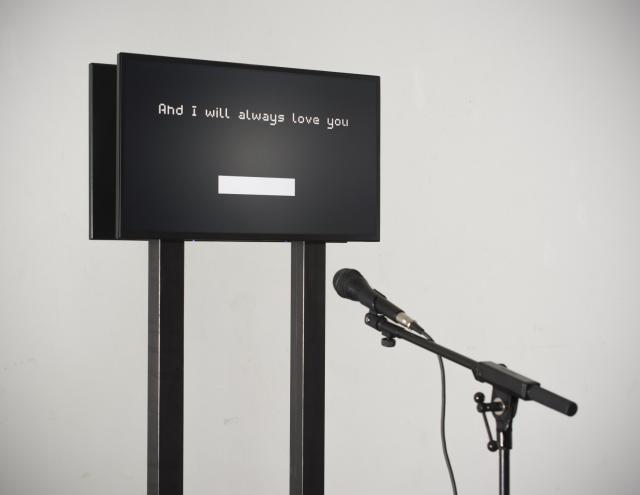
What do machines sing of?, a multimedia installation by German artist Martin Backes consisting of a fully automated machine that endlessly sings top-chart ballads from the 1990s. As the custom-made computer program performs these emotionally l...read more
multimedia installation
exhibition opening and artist talk: tuesday, April 12th 2016, 8pm
exhibition is open on April 13th and 14th 2016, from 5pm to 8pm
@ big hall of Pogon Jedinstvo, Zagreb, Trnjanski nasip bb
What do machines sing of?, a multimedia installation by German artist Martin Backes consisting of a fully automated machine that endlessly sings top-chart ballads from the 1990s. As the custom-made computer program performs these emotionally loaded songs, it attempts to introduce the appropriate human sentiments. This behavior seems to reflect the machine’s desire to present itself as sophisticated enough to have its very own personality.
Martin Backes (1977), a Berlin-based artist, designer, performer, composer, and lecturer. He has studied Media Art & Design as well as Sound Studies at the University of Arts in Berlin. In his work, he often uses media technologies to reflect certain functionalities, effects, ideologies, and human perception. Backes’ cross-border and experimental activity in the intermediate area between art and science ranges from sculptural and multimedia sound projects to interventions in public space and installations, as well as radio plays and computer/video works. He has presented his work at various international exhibitions and festivals.
contact: www.martinbackes.com